
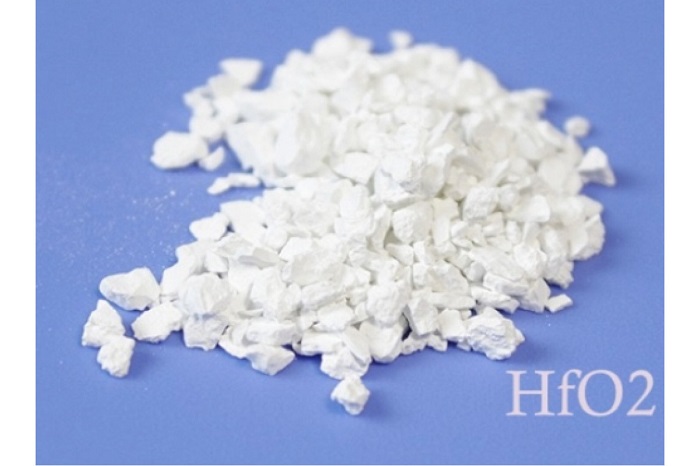
Hafnium oxide (HfO2) is an inorganic compound of hafnium and oxygen, belonging to the class of refractory oxides. In materials science, it is recognized as a highly stable ceramic characterized by significant chemical inertness and the ability to retain its properties when exposed to high temperatures, aggressive environments, and radiation.
Interest in HfO2 stems not only from its thermal stability but also from its important electrical characteristics, such as a high dielectric constant and low leakage currents in thin films. Consequently, hafnium oxide has become a key material at the intersection of microelectronics, optics, and protective coatings.
What is HfO2 and what are its properties?
The chemical nature of HfO2 and holmium oxide is defined by strong bonds between hafnium and oxygen atoms, which render the material highly insoluble and resistant to oxidation.
Depending on the temperature and synthesis conditions, hafnium oxide can exist in several crystalline modifications and can also form solid solutions with structurally similar oxides.
Key Physicochemical Characteristics
- High melting point, making the material suitable for high-temperature components and coatings.
- Chemical resistance in oxidizing and many corrosive environments.
- Dielectric properties: high dielectric constant, which is important for thin-film structures.
- Optical transparency across certain ranges and a high refractive index, useful for optical layers.
- Mechanical hardness and wear resistance, typical of oxide ceramics.
Forms and Typical States
In practice, HfO₂ is used both as a powder (for sintering ceramics) and as thin films, which are produced via methods such as chemical vapor deposition, atomic layer deposition, and magnetron sputtering. The thin-film state is particularly important in applications where thickness, uniformity, and the ability to control electrical parameters are critical.
Chemical Formula, Valence States, and Crystal Lattice Type of HfO₂
Hafnium oxide has the chemical formula HfO₂, reflecting a 1:2 stoichiometric ratio of elements, which is characteristic of stable hafnium dioxide. In this compound, the hafnium atom is bonded to oxygen atoms primarily through ionic-covalent bonds, which accounts for the material’s high chemical and thermal stability.
The combination of a fixed stoichiometry, characteristic valence states, and crystalline polymorphism defines the key properties of HfO2—namely, high dielectric constant, robustness, resistance to oxidation, and the ability to maintain its parameters at elevated temperatures. These attributes are essential for applications in electronics, optics, and protective coatings.
Summary
Hafnium oxide is characterized by several fundamental features: the chemical formula HfO2, dominant valence states of Hf(+4) and O(-2), and the existence of multiple stable crystalline lattice modifications.
- Chemical formula: HfO2—a stable hafnium dioxide with a stoichiometry typical of dioxides formed by a tetravalent metal.
- Valence states: Hafnium primarily exhibits a +4 valence, while oxygen exhibits -2; deviations from ideal stoichiometry are typically linked to defects (such as oxygen vacancies), which influence conductivity and dielectric losses.
- Crystalline lattice (polymorphism): Depending on temperature and synthesis conditions, the material can adopt monoclinic, tetragonal, or cubic crystalline forms; these structural transformations allow for the targeted tuning of material properties to suit specific applications.
Thus, the combination of its chemical formula, stable Hf(+4) valence state, and polymorphic crystalline structure explains why HfO2 remains one of the most sought-after functional oxides for modern technological applications.