
When commercial garment decorators scale a direct-to-garment (DTG) printing line from ten sample shirts a day to hundreds of retail cotton garments per shift, the curing station determines both hourly line throughput and finished textile hand-feel: while a contact heat press cures small batches at low capital cost, an airflow-controlled conveyor tunnel dryer evaporates water vapour evenly without crushing the cotton pile or flattening the matte texture of water-based DTG ink.
Understanding how convective hot-air curing differs mechanically from conductive contact pressing helps print shop owners match their drying equipment to their DTG printer’s hourly output and wash-fastness targets.
Why Water-Based DTG Ink Curing Is a Two-Stage Moisture and Cross-Linking Process
Unlike traditional plastisol screen-printing ink, which contains zero water and simply needs to reach its fusion temperature for a few seconds, water-based DTG pigment ink and liquid pre-treatment contain a high percentage of water carrier. Regardless of whether an operator uses a heat press or a tunnel dryer, the ink film inside a cotton garment cannot reach its chemical cross-linking temperature while liquid water is still boiling off inside the yarn.
Every DTG curing cycle therefore runs through two distinct physical phases:
- Phase 1 — Moisture evaporation and steam exhaust: Heat must first drive water out of the cotton fibres and pre-treatment layer as water vapour; mientras water is evaporating, evaporative cooling holds the fabric temperature near 100 °C.
- Phase 2 — Polymer binder cross-linking: Only after the print zone is bone-dry does the garment surface temperature climb to the ink manufacturer’s required cross-linking window (typically 150–165 °C depending on ink chemistry) to lock pigments permanently around the cotton fibres.
Side-by-Side Comparison: Contact Heat Press vs. Conveyor Tunnel Dryer for DTG
Print shops planning floor space, electrical circuits, and operator staffing should compare contact heat presses and conveyor tunnel dryers across four production metrics.
| Curing Dimension | Clamshell / Drawer Contact Heat Press | Airflow Conveyor Tunnel Dryer (Electric / Gas) | Shop-Floor Decision Guideline |
|---|---|---|---|
| Moisture & steam escape path | Upper platen traps steam unless hovered, vented mid-cycle, or paired with breathable mesh sheets | Continuous forced-air circulation and exhaust hood pull steam away from the open garment surface | Tunnel dryer eliminates trapped-steam wash failures on heavy dark-garment ink loads |
| Finished garment hand-feel & sheen | Direct platen pressure flattens cotton knit loops and can leave a slightly pressed sheen over the ink box | Non-contact radiant/convective heat preserves the natural loft and ultra-matte textile texture of cotton tees and hoodies | Retail fashion accounts strongly prefer the un-crushed, lofty matte finish of tunnel-dried DTG |
| Operator labour per garment | Requires manual loading, hover/press timing, sheet placement, and unloading for every single shirt | Operator simply lays the printed shirt flat onto the moving entry belt; unloading can feed directly to folding tables | One tunnel dryer easily handles the continuous output of one or more dual-platen DTG printers |
| Pre-treatment drying vs. final ink curing | Still essential right beside the DTG printer for pre-press fibre smoothing before printing | Best dedicated to final ink curing (or high-volume pre-treatment tunnel drying with a separate post-dry flattening press) | Even shops with a large tunnel dryer keep a contact heat press at the DTG loading station to flatten cotton fuzz before print |
Why Every Tunnel-Dryer DTG Shop Still Keeps a Heat Press at the Platen
A common question from print shop owners upgrading to an automated conveyor tunnel dryer is whether they can sell or retire their flatbed heat presses. In a high-quality commercial DTG workflow, the answer is no: conveyor dryers and contact heat presses perform different jobs at opposite ends of the production line.
Before a dark cotton shirt enters the DTG printer, its pre-treated surface must be pressed flat under mechanical contact pressure so stray cotton fibrils cannot poke through the wet white underbase. A non-contact tunnel dryer evaporates water cleanly, but it cannot iron protruding cotton fuzz flat against the jersey weave. High-output DTG departments use a quick contact heat press upstream of the printer to lock pre-treated fibres flat, and then place the printed garment onto the non-contact conveyor tunnel dryer belt downstream so the finished ink cures with a soft, lofty matte finish.
Aligning Commercial DTG Hardware Output With Curing Line Capacity
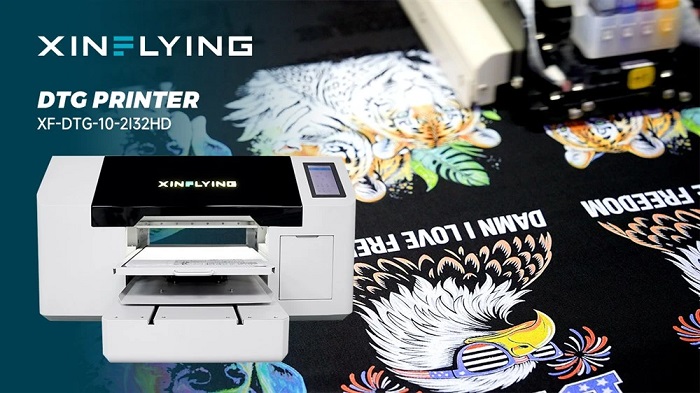
Matching printer throughput to curing capacity prevents costly mid-shift pile-ups where freshly printed wet shirts sit waiting on racks before curing. Shop owners evaluating compact commercial DTG systems such as the XINFLYING XF-DTG-10—or scaling up to dual-platen industrial machines like the XF-DTG-20 and heavy-duty XF-DTG-380—can review the complete specifications across XINFLYING DTG printing machines to coordinate hourly garment output with their pre-press and tunnel-drying layout.
By pairing a reliable commercial platform like the XINFLYING XF-DTG-10 with upstream contact fibre-flattening and downstream airflow-verified curing, garment decorators achieve both superior retail wash fastness and a natural, un-flattened cotton hand-feel.